
Standby and portable hookups
Power goes out here. Winter storms bring wind and ice down on lines across the county, upper-county outages at elevation can run long, and if you’re on a well, losing power means losing water at the same time you lose heat. A properly installed generator turns a multi-day problem into an inconvenience. An improperly installed one can kill a lineman.
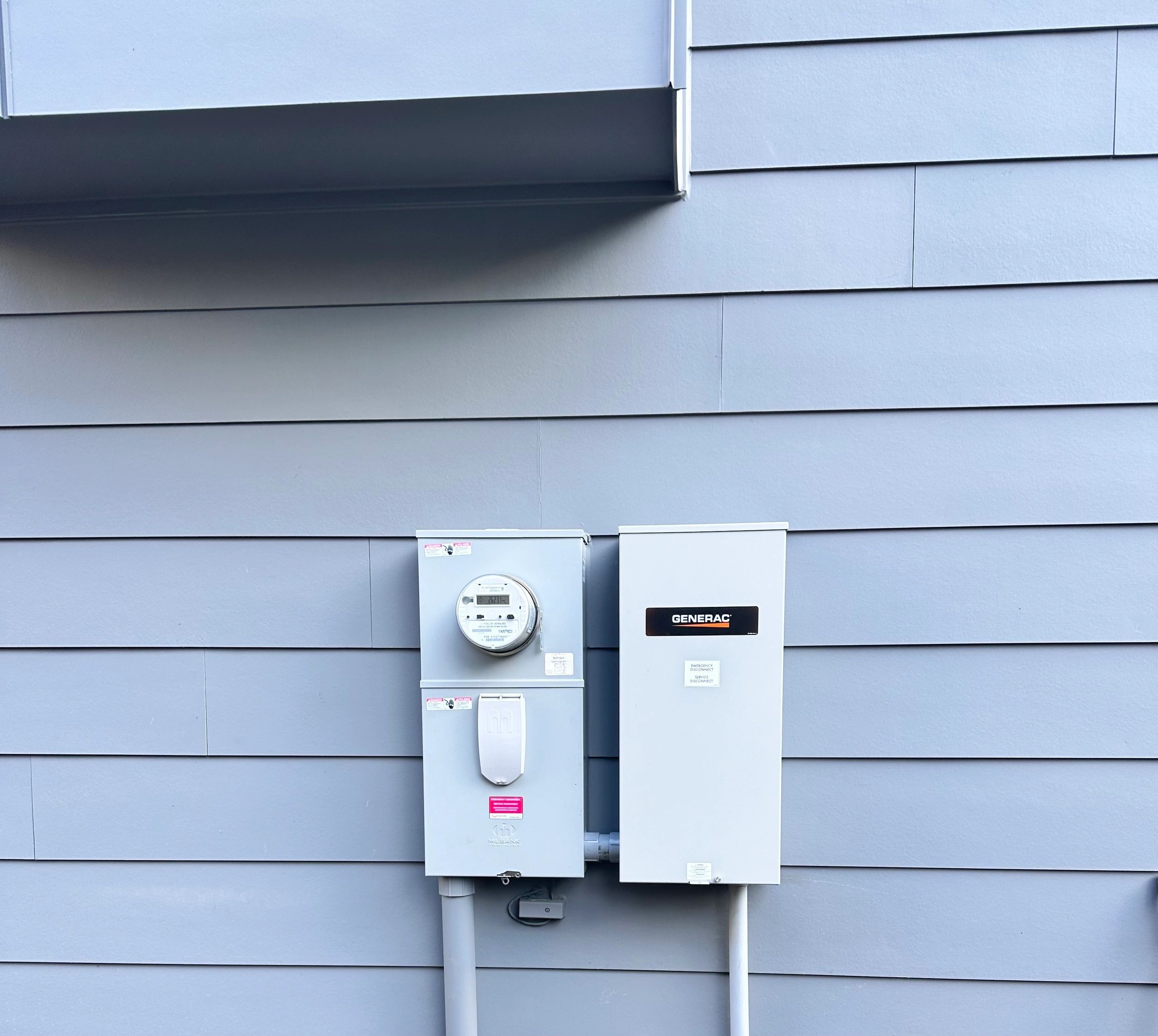
Standby generators are permanently installed outside, wired to your electrical system, and fueled by propane or natural gas. Paired with an automatic transfer switch, the unit senses the outage, starts, and transfers your loads over, typically within a minute, whether or not anyone’s home. When utility power returns it transfers back and shuts down. That last part matters more than people expect — half the value of a standby unit is that it works while you’re at work, or out of town, in February, with a house full of pipes.
Portable generators cost far less and require you to be present, awake, and willing to go outside and start them. Connected properly through an inlet and a manual transfer switch or interlock, they’ll run a defined set of critical circuits. That’s a legitimate choice for a lot of households — it just isn’t the same product.
We install and wire both. Which one is right depends on how long your outages actually run, whether you have a well, whether you’re regularly away, and what your budget is.
The Transfer Switch Is the Part That Matters
Read this one even if you skip the rest
A generator must be connected through a transfer switch or an approved interlock — a device that makes it physically impossible for generator power and utility power to be connected at the same time. Without one, generator power can push back out through your service and onto the utility lines. That’s called backfeed, and it energizes lines that a utility crew has every reason to believe are dead. It’s a known way to kill a lineman working to restore your neighborhood’s power. It can also destroy your generator and start a house fire when utility power returns.
The workaround people find online is a suicide cord — a cable with male plugs on both ends, run from the generator into a dryer outlet. It backfeeds the entire service with no isolation whatsoever. We will not connect one, and we’d ask you not to use one.
A proper installation includes an inlet box, a transfer switch or panel interlock, and correct grounding and bonding. It’s permitted and inspected work. It isn’t expensive relative to the generator itself, and it’s the difference between a backup system and a hazard.
Sizing It Correctly
Starting loads, not running
Undersized generators are the most common complaint we’re called out to fix, and the mistake is almost always the same: adding up running watts and forgetting starting loads. Motors — well pumps, furnace blowers, refrigeration compressors, heat pumps — draw several times their running current for the moment they start. A well pump that runs at 1,500 watts can spike far above that on startup, and if the generator can’t absorb it, the unit stalls or the pump doesn’t start.
For a whole-house standby unit, we do a load calculation. For a critical-loads approach, we work out which circuits genuinely need to stay up — usually well pump, heating controls, refrigeration, a few lighting circuits and communications — and size to those. The critical-loads route is very often the better value, particularly on rural properties where the well is the real priority.
Fuel matters too. Propane is the common choice on rural Kittitas County properties without gas service, and tank sizing needs to account for how long outages actually last here, not a manufacturer’s optimistic runtime figure.
Rural properties in the upper county, around Cle Elum, Roslyn, Ronald, Easton and toward Snoqualmie Pass, see both the longest outages and the highest consequences — wells, electric heat, elevation and winter access all in the same place. Ellensburg proper generally sees shorter outages, but a well-served town still loses power to wind events, and businesses with refrigeration, servers or scheduled operations have their own reasons for standby power.
Electrical work in Washington requires a permit and inspection, and generator interconnection is exactly the kind of work an inspector should see. We handle it.
Frequently Asked Questions
Standby or portable — which should I get? Standby if you’re often away, on a well, or want power back without doing anything. Portable if you’ll be home during outages and want to cover a few critical circuits for far less money. Both are legitimate choices.
Do I need a transfer switch for a portable generator? Yes — a transfer switch or an approved interlock, with a proper inlet. Without one, a generator can backfeed the utility lines and endanger line crews. We won’t connect a generator any other way.
Can a generator run my well pump? Yes, if it’s sized for the pump’s starting load, which is several times its running load. That’s the most common sizing mistake we fix.
Do I need a permit? Yes. Generator interconnection is permitted and inspected electrical work in Washington. We handle both.
Propane or natural gas? Natural gas where you have service. On rural Kittitas County properties without it, propane — with the tank sized for how long outages actually last here.
Call 509.264.5678 for a written estimate.
Recent Generator installation projects
Related electrical services
Also serving Central Washington
Ellensburg, Cle Elum, Roslyn & Ronald, Snoqualmie Pass & Easton, Yakima & Selah, Wenatchee Valley, Moses Lake & Grant County
