EV Charger Installation in Ellensburg & Kittitas County
Level 2 charging, done right
Installing a Level 2 charger at home is usually a straightforward day of work. The part that trips people up is what's behind the wall — whether your existing service can carry the load, and what it costs if it can't. We do the load calculation first, tell you honestly which situation you're in, and install accordingly. Sometimes that means a service upgrade. Often it doesn't, and we'll say so.
What a Level 2 Charger Actually Needs
Sized at 125%, not 100%
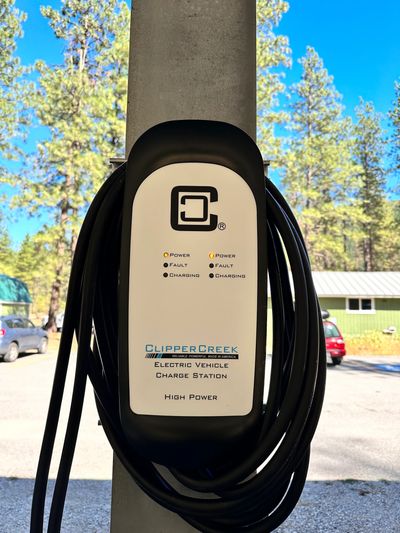
Level 2 charging runs on 240 volts, and an EV charger is what the code calls a continuous load — it pulls its maximum rated current for three hours or more without a break. That means the circuit has to be sized at 125% of the charger's rating, not 100%. In practice: a 32-amp charger needs a 40-amp circuit, a 40-amp charger needs a 50-amp circuit, and a 48-amp charger needs a 60-amp circuit. The most common mistake we're called out to fix: someone installs a NEMA 14-50 receptacle on a 50-amp circuit expecting 50 amps of charging. A plug-in unit is limited to 80% of the circuit rating, so that setup gives you 40 amps, about 9.6 kW. If you want 48 amps and 11.5 kW, the charger has to be hardwired. There's no way around it. Your charger also needs its own dedicated circuit, and GFCI protection is required. Most listed chargers have that protection built in — adding a second GFCI device on top of it causes nuisance tripping, which is a service call we get more often than you'd think.

Do You Need a Service Upgrade?
Two code-legal ways around it
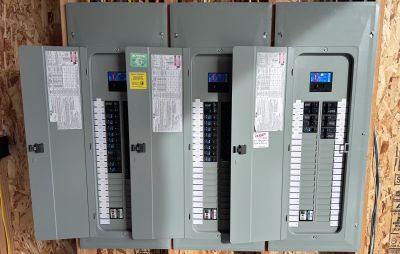
Here's where a lot of homeowners get an expensive answer to a cheap question. Code requires an EV charger to be counted in your service load calculation at a minimum of 7,200 VA, or its nameplate rating, whichever is larger, at full value. Run that against an older 100-amp service that already has an electric range, a dryer, and electric heat, and the math often fails. That's the point where a lot of contractors quote a service upgrade. But there are two legitimate ways around it. The first is a real-world load measurement. Rather than assuming worst-case demand, the code allows existing load to be established from actual utility demand data, or from a minimum 30-day recording taken under normal use including seasonal heating and cooling. Real houses draw far less than the theoretical calculation assumes. We've had 100-amp services pass this way that would have failed on paper. The second is load management. A device that lets the charger shed or share capacity, pausing while the dryer runs for instance, means the charger doesn't have to be counted at full value. That frequently turns a several-thousand-dollar service upgrade into a modest add-on. Neither of these is a workaround or a shortcut. Both are explicitly permitted. They just take more effort than quoting a service replacement, which is why not everyone offers them. If your service genuinely can't support the charger, we'll tell you that too, and we'll size the new one properly — usually 200 amps, sometimes 400 if the rest of the property calls for it.
Rebates and Tax Credits: The Honest Picture
Current as of August 2026
Most of what you'll read online about EV charger incentives is out of date. Here's where things actually stand. The federal tax credit is gone. The Section 30C credit for EV charging equipment expired for anything placed in service after June 30, 2026. If your charger was energized on or before that date, you can still claim it on your 2026 return. If it goes in now, there is no federal credit. Any contractor still advertising one is working from old information. Washington's sales tax exemption is also gone. The state exemption that covered EV charging equipment and installation labor expired July 1, 2025. Equipment and labor are both fully taxable now. There is currently no Washington state rebate for a residential EV charger. One rebate does still exist, but only for some addresses. Puget Sound Energy offers up to $300 toward a qualifying ENERGY STAR smart Level 2 charger, and more for income-qualified customers. The catch is that it's for PSE electric customers only. This matters a lot in Kittitas County, because there are three different electric utilities here. If you're inside Ellensburg city limits, your power comes from the City's own municipal utility, so the PSE rebate doesn't apply to you. Unincorporated areas are largely Kittitas County PUD. PSE serves parts of the county. Which rebate you qualify for depends entirely on who bills your electricity, and we'll tell you which one you're in before you count on anything.
Commercial and Multifamily Charging
Workplace, fleet and MDU
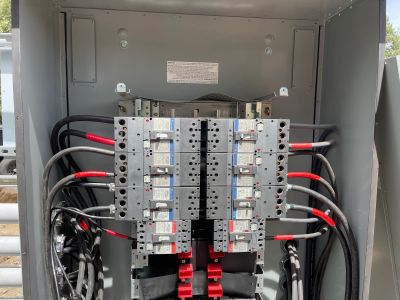
Workplace, fleet, and multifamily charging is a different scope: load studies across the whole building, service capacity planning, conduit infrastructure for future ports, and networked equipment with usage tracking and billing. We handle commercial EV installations across Central Washington, including public works and government facilities. State grant programs for multifamily and public charging have run in funded rounds — none are currently open, and the next depends on the legislative session beginning January 2027. If you're planning a project, that timing is worth knowing about.